Print Club vs Newsletter: Which Format Fits Your Audience.
A newsletter lands in an inbox at 7am. A print club lands on a doormat in a brown kraft envelope. The two do very different work - and choosing wrongly is expensive.
- Print Club Society
- May 27, 2026
- print club · newsletter · subscriptions · studio practice · mail
Every month, somewhere between the studio and the post office, a decision gets made twice. The first time was years ago, when a maker sat down and asked themselves whether the thing they wanted to send into the world was a letter or a print. The second time is now, every issue, when they sit down to make it again. The two formats look adjacent - both are subscriptions, both are intimate, both arrive on a schedule. But they are not interchangeable, and the studios that thrive in one would quietly suffocate in the other.
This piece is for the maker weighing them up. It is also, honestly, for the reader trying to work out why some subscriptions feel essential and others feel like homework.
What each format actually is
A newsletter is a piece of writing that arrives by email. Its medium is the screen, its unit is the sentence, and its cost-per-issue is effectively zero. You can publish a newsletter from a hotel room. You can publish a newsletter the morning of, after a sleepless night, and nobody will know.
A print club is a physical object - usually a single print, sometimes a print plus an envelope of small ephemera - sent by post to a list of subscribers each month or each quarter. Its medium is paper, its unit is the edition, and its cost-per-issue is real and stubborn: ink, stock, sleeves, mailers, postage, the trip to the post office in the rain. You cannot publish a print club from a hotel room. You can barely publish one without a press.
That asymmetry is the whole argument.
What a newsletter is good at
Newsletters reward velocity, voice, and volume. If your work is fundamentally about language - criticism, interviews, recommendations, reportage, a recurring argument with the world - the inbox is your natural habitat. You can publish weekly. You can correct yourself the next day. You can link out, embed, quote at length, and respond to something that happened on Tuesday by Wednesday morning.
Newsletters are also forgiving of inconsistency. A great issue compensates for a thin one. Readers forget the misses and remember the hits, because the format itself is ephemeral.
What newsletters are bad at: lasting. An email is read once, maybe twice, and then archived into the soft oblivion of an inbox. Nobody frames a newsletter. Nobody tapes one above their desk for a year. Nobody opens a drawer in 2031 and finds last March's issue and feels something.
What a print club is good at
A print club rewards the opposite virtues: restraint, consistency, and craft. The work has to survive the journey - through a sorting office, a letter slot, a kitchen table - and still feel like an event when it's unwrapped. That pressure is clarifying. It forces a maker to ask, of every issue, is this print actually worth the postage? Most newsletters never have to answer that question.
It also produces a different kind of reader relationship. A subscriber to Nicola Woodcock in Sydney isn't waiting to be informed; she's waiting to be given something to put on a wall. A subscriber to Egypt Print Club isn't reading about Cairo, she's holding a piece of it. The exchange is closer to a gift than a broadcast.
"People keep our envelopes," one printer in Lisbon told me last spring. "They don't keep my emails. I love both, but the envelopes are the work."
The honest test: what is the unit of value?
Here is the question I ask any maker who is genuinely torn between the two. Picture your subscriber a year from now. What do you want them to have?
- If the answer is a body of thinking- a running thread, a relationship with your voice, a shelf of bookmarked links - make a newsletter.
- If the answer is a stack of objects- twelve prints in a portfolio sleeve, a wall they've slowly built, a drawer they reach into - make a print club.
- If the answer is both, then the print is the product and the newsletter is the porch light. Many of the studios in our directory run exactly this way: monthly mail, occasional letter.
Audience economics, briefly
A newsletter at scale is a writer's business. A print club at scale is a small manufacturing business. This sounds obvious until you watch a maker discover it the hard way at four hundred subscribers, surrounded by uncut paper, realising the print run that felt romantic at fifty has become a full second job.
The print clubs that endure tend to do one of three things: cap the edition deliberately, raise the price to match the labour, or build the studio out so the labour is shared. Some, like The Brambletown Mail Club, lean into the seriality of it - the parcel as instalment, the reader as someone collecting a story over time. Others stay small on purpose and never advertise.
If you're a studio thinking through any of this, our step-by-step guide to starting a print club walks the operational side in detail, and our membership tiers are where you list when you're ready to be found.
The hybrid most people end up at
In practice, the cleanest division is this: the print club is the product; the newsletter is the studio window. The newsletter is where you talk about the press, the misprints, the trip you took to find the colour. The print itself stays unspoken - wrapped in tissue, in a kraft envelope, with a postmark.
Pick the wrong one and you'll feel it within six months. Pick the right one and the work, finally, becomes the thing the work is about.
Print clubs in this story.
Keep reading.
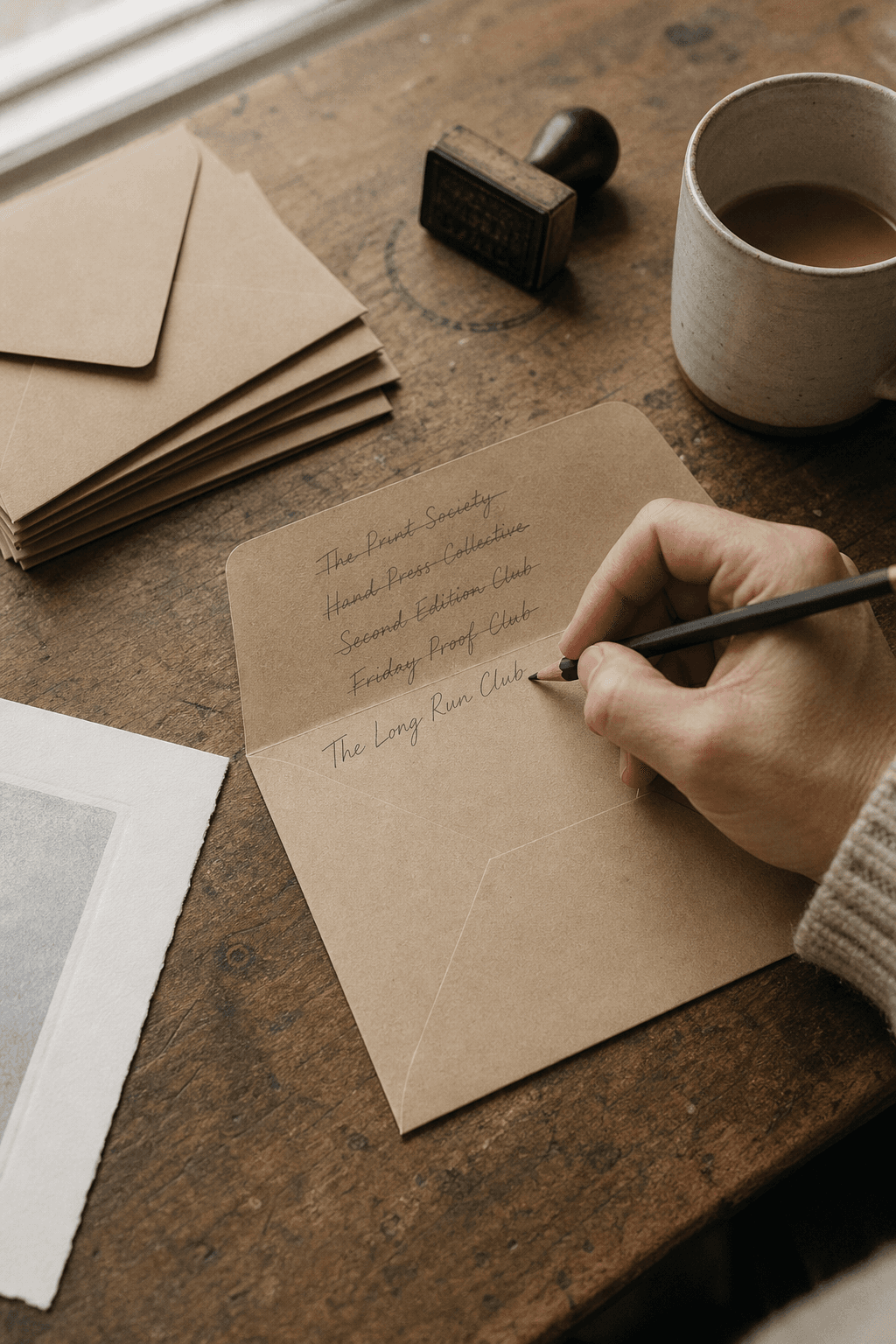
Naming Your Print Club: 40 Ideas and a Practical Framework
A name has to survive the kraft envelope, the spreadsheet, and the second year. Here's how the best print clubs got theirs - and forty starting points if you're still staring at a blank page.
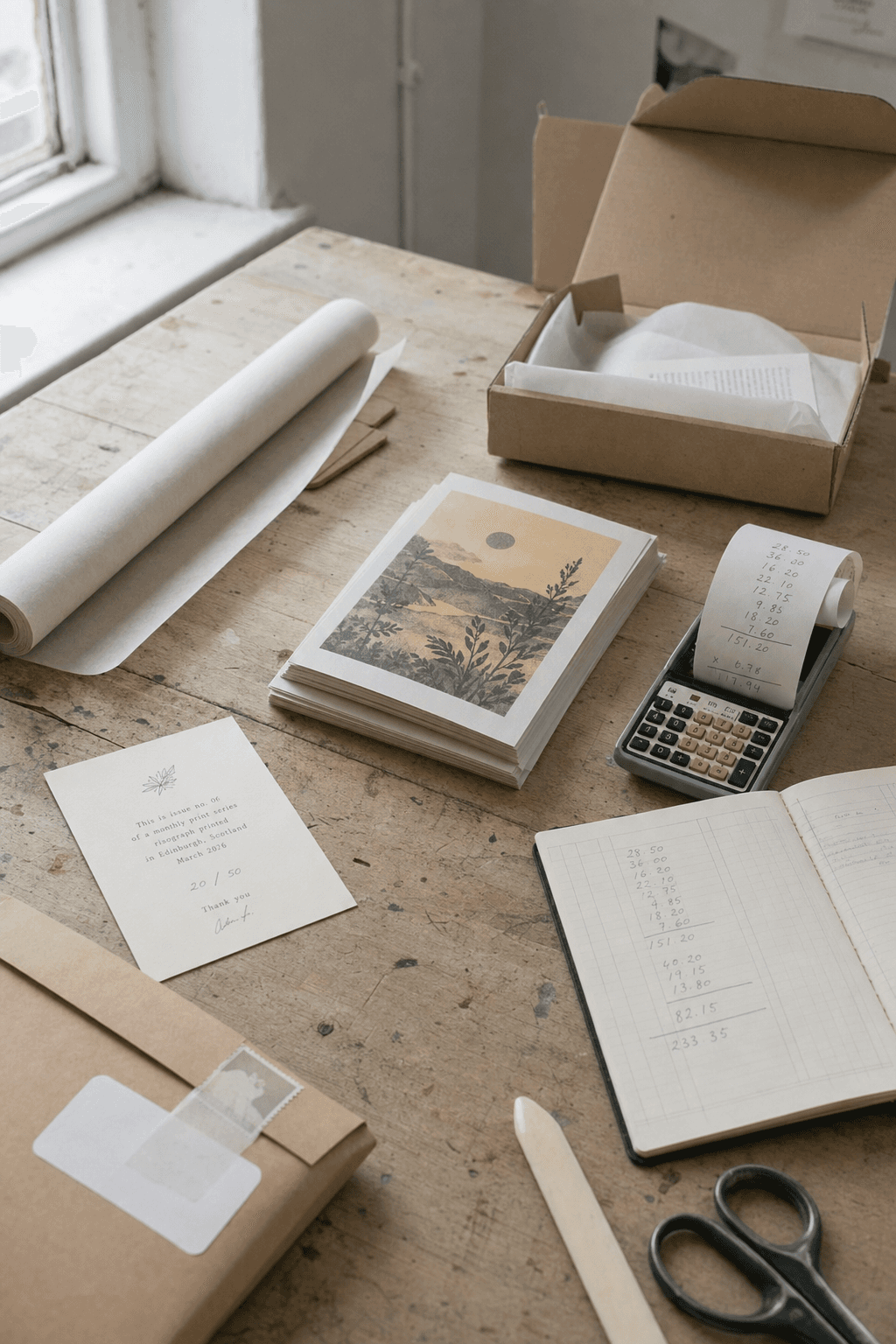
How Much Does It Cost to Start a Print Club?
A line-by-line breakdown of what it actually costs to launch a print-by-mail club in 2026 - from the press in the corner of the studio to the postage on the first parcel.

15 Print Club Niches That Still Have Room to Breathe
The mail-club shelf is crowded with botanicals and tarot cards. Here are fifteen subjects we'd subscribe to tomorrow - and the printers brave enough to try them.